IMPULSE SCANNER
SCANNER GUIDE
Crypto impulse scanner: price, volume and confirmation settings
Find markets where a price move coincides with increased trading volume. This guide explains the free web scanner’s actual detection rules and the meaning of a confirmed event.
Impulse Scanner team · Updated 22 October 2026
What the scanner calls an impulse
The web edition analyses USDT futures on Binance, Bybit, OKX and BingX. Price change runs from the selected window’s opening price to the latest completed candle’s close. The price threshold applies to the absolute change, so a 2% setting can detect either direction.
This is a detector rule, not a universal definition. The markets table can show moves that have not qualified for the Impulses tab.
Worked example: 15m, 2%, ×3
An opening price of 100 and closing price of 102.5 give a +2.5% move. Relative volume of ×3.4 also clears the ×3 threshold, creating a candidate.
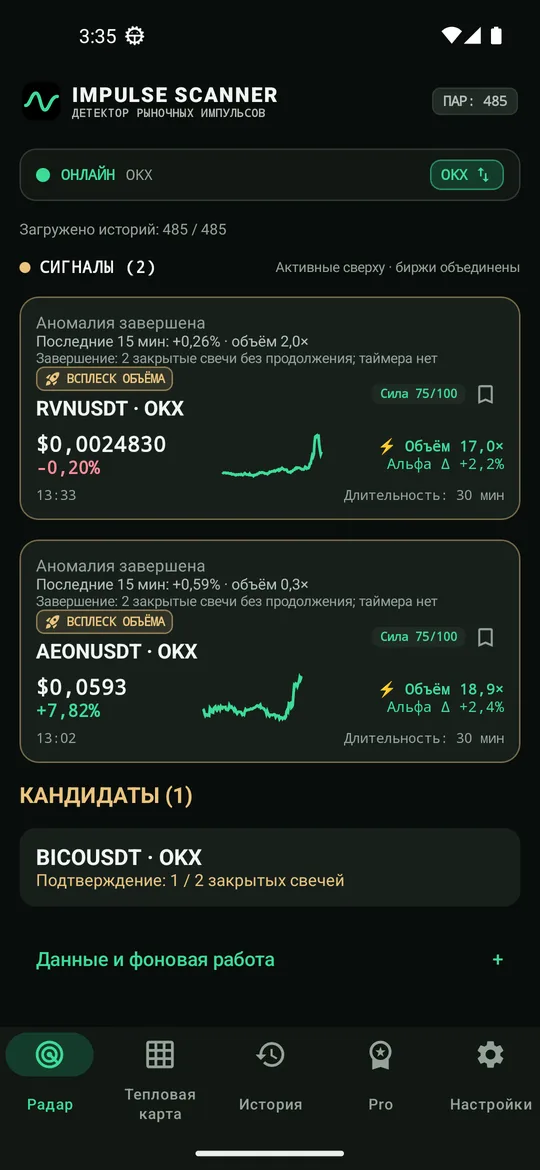
With two confirmations, the next completed 15-minute candle must retain the direction, at least 75% of the price threshold, and at least 80% of the volume threshold when required. Here the retention boundaries are 1.5% and ×2.4. These are separate candle observations, not duplicate network responses.
Why detection follows the price move
The web scanner uses completed 15-minute candles. Its 1h, 4h and 24h windows are built from those candles. Reloading does not make detection tick-based; a second confirmation requires another close. Longer windows also require enough continuous history.
Check analysed market counts and freshness. Missing history is not evidence that a market is quiet.
Adjusting sensitivity
- Select an exchange and coverage, then apply settings.
- Observe the default 15m / 2% / ×3 / two-confirmation configuration.
- Change one threshold at a time. Lower price and volume thresholds admit more candidates.
- One confirmation reduces the wait but does not test whether the move survives the next check.
- Inspect the chart and data availability before interpreting the event.
These are interface examples, not a validated trading strategy. A trigger does not predict continuation, reversal or returns after fees.